 I can answer that question for us at the Potwell Inn because one of our children suffered from his earliest months from what was thought to be lactose intolerance. It turned out to be something else and he’s now approaching forty and in good health, but that’s not the point. For us that possibility – in the era before smartphones – meant that shopping became a nightmare in which small print was obsessively pored over and during which we carried a long printed list of safe foods which had to be updated every few weeks because manufacturers would change recipes and what was ‘safe’ one week would contain lactose a month later. Lactose was a cheap and easy recipe component that found its way into the most unexpected places. What that experience did – and this is the takeaway point – was to pathologise food for us. We were in an unusual and rare position and eventually, after several years of hospital admissions, it became clear that lactose wasn’t the underlying problem and things kind of settled down again.
But once pathologised, food never really recovers and for many of us the relationship with it has become damaged. ‘Lucky you’ you could justifiably say if you’re a subsistence farmer or relying on food banks to get through the week. What shameless narcissistic self-indulgence to be prattling on about the dangers of food when you’re so rich you can afford to throw it away. ‘Just give us a share in that dangerous stuff you’re so scared of eating!’ This isn’t just an abstract ethical issue. Last night we were late getting home and I resorted to buying a ready meal (yes really) at the local supermarket just before it closed – you should try it some time, it’s an eye opener. There was a significant proportion of obviously poor people snapping up the reduced price food before it went to the bins. I even spotted one man who I know to be a street beggar with a basket of food. It was a big jolt, we mostly prefer poverty to be on the other side of a high cultural wall – who needs concrete and steel? Wouldn’t we rather they waited an hour and stole it from the waste bins at the back or is it just their pride that stops them?
But for the lucky ones, aided by countless newspaper and television programmes, the message has become imprinted in our minds that food is potentially dangerous and by micromanaging our food intake we can live longer lives. It’s a no-brainer as we all know, and so whilst we are fortunate enough (most of us) to live in the Promised Land flowing with milk and honey [Oh my God, milk? factory farmed and lethal: and honey? – unless it’s manuka honey at £15 a gram – pure lethal carbohydrate]; many who can afford it live on an aetiolated diet that keeps them perpetually anxious and those who can’t, eat manufactured junk that gives you diabetes and makes you fat, and disabled by shame and guilt. Of course we all smile bravely and tell ourselves we’re really happy but:
We’re secretly as miserable as it’s possible to be!
Having a bad relationship with food, and tap water, and the air we breath, and with any number of ordinary indispensible aspects of our lives is so widespread that we hardly notice it, and when we do notice there’s often an ‘expert’ on hand to help us through. But all too often the experts want to sell us their remedy rather than attack the basic problem. So we buy processed ‘slimming meals’ – there’s an oxymoron for you. We lug vast quantities of bottled water around and – if we can afford it – buy organic food not realizing that the major producers have negotiated exemptions on the use of many chemicals we assume we paid extra to be spared from. We buy food supplements and herbal snake-oil in case they can stave off old age. Our behaviour, and especially our children’s behaviour, has been pathologised as well and we medicate five year olds in order to make them more ‘normal’. Our relationships, our culture and family life and sadly our dependence on bacteria (think only of our terror of rotting, even controlled rotting) have all been pathologised too and we’re frightened of a caterpillar on our cabbage and a bit of dirt on a potato, so we’re reduced to buying happiness on interest free credit from some behemoth that knows that the effect wears off when you unwrap it and then you’ll buy some more. Surely this can’t be good?
The Potwell Inn doesn’t actually have a ‘mission statement’ because trying to express the idea of flourishing without getting into psychobollocks, merchandising and quackery is harder to do than you’d imagine. But ironically we all know what flourishing feels like even if we can’t put it into words. Equally a discussion about ‘being fully human’ is fraught with difficulties in a society that runs away screaming if it senses that even a mention of humanness is attempting to chainsaw the legs off diversity. When did we get so scared of food? When did we get so scared of getting old? When did we get so scared of germs, or other people, or commitment, or thinking about hard stuff?
The Potwell Inn stands for flourishing and not, most certainly not just happiness which is an ephemeral pleasure that’s always ready to be driven out by the next dark fear. It’s flourishing we’re committed to and in order to flourish we believe that we need to overthrow the tyranny of pleasure altogether. I’m talking about both ancient (how about Aristotle?) and modern – Positive Psychology [feel free to skip a sentence whenever your mind clouds over]. I’m no academic, but if I were, I’d be looking at the work the Jubilee Centre at the University of Birmingham (UK) is doing.
What I am completely committed to doing is discovering through experience – through growing and harvesting and cooking; through making and thinking, and learning not to be scared of my neighbours, and – to steal a phrase from Ernest Hemmingway in a letter to his daughter, “to recognise bullshit when you see it”; I’m learning about flourishing. What I’m conducting is a very practical experiment with the hope I might be able to share the results with a few other people. It’s called the Potwell Inn because it’s open to anyone (except if you’re barred by the landlord for being a pain) and it’s a place of joy.
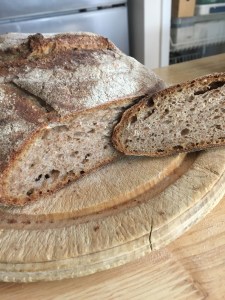 It’s inevitable when you make bread regularly that just now and again you’ll get a batch that refuses to play. This isn’t just a problem with home baking – I can remember many occasions when we lived in a large village that still had its own bakery, and occasionally there would be a queue outside the door because Brian (the baker) was having problems with an overnight batch. You could hardly blame lack of experience in his case because he’d been baking in the family business since the days when he delivered the bread to the outlying hamlets in a horse and cart. A dud batch can affect anyone.
 The season for cod roe seems to have come and gone without me spotting any at all but as for marmalade I had an email from Potwell Inn friend Mags who had read my piece a couple of weeks ago. She tells me she boils the fruit whole for 2 hours before removing the pulp into a muslin bag and slicing the peel. She says it’s less time consuming and in any case makes better flavoured marmalade with less sugar – so tomorrow I’ll give it a go and report back on the results. The new batch demands another dozen new jars – I really thought we’d never have to buy another jar or lid but somehow all this preserving and pickling has used them all.


 I never for a single moment thought I would be writing this, but last summer, on the basis of no more than a mention in a biography, we salted some runner beans just to see what would happen. Here at the Potwell Inn we read a lot of books – I mean a lot of them – and among them was the new biography of Patience Gray entitled Fasting and Feasting written by Adan Federman – and so when, in a passing remark, her son Philip said he actually preferred the taste of salted beans to their fresh counterparts, we were unable to resist.


 So beds it is, and no-dig beds it’s going to be. As I was clearing the last of the parsnips from one bed it was very pleasing to see how straight and unforked they are, and I wish we could claim some responsibility for the success of the crop but they were thrown in much too late as an experiment. Next season we’ll do it properly.
 But the collapse in pollinating insects is the really big worry – not just for gardeners and allotmenteers but for the multitude of small mammals and birds who rely on them for food. So the next stage on our allotment, after ground clearing is the establishment of food plants not just for the Potwell Inn but for all the insects and small mammals we need to support. The earth isn’t just there for our convenience. So this year we’re having a big push on foodplants, nectar flowers and companion plants. We only ever share our land, and we’ve got nets and fleece and (for sweetcorn) hard barriers to preserve the bits we really need, but that brings the responsibility to look out for the needs of the other inhabitants of the land. An allotment is a pretty intensively cultivated environment but that doesn’t mean we have to regard the rest of the natural world as a threat. The link to the article is below.
 I think I might be a bit of a perfectionist. I had three hours on the allotment this morning while Madame cultured the cold I was good enough to share with her last week, and so I took this photo of the bed I dug today so I could show her when I got back to the flat. But what do I see when I put it on the screen? Any sensible person might have paid attention to the neat bed and its readiness for planting up in the spring. All I could see was the tiny bit of couch root at the bottom left hand corner that I’d managed to overlook. Pefectionism is a blight and it’s often accompanied by being unable to choose between several almost identical course of action. Should I drive the pegs for the boards into the paths or the beds? There’s much to be said for either course of action and I’ve wasted hours wondering about it.
 In fact our shed has turned out to be a bit of a disappointment. Since it got so full of – things – it’s impossible even to step into it, but I made a flask of tea and resolved that I would take a break now and again just to contemplate the fruits of our labours and dream of next season. Three hours later Madame rang me on the mobile and asked if I’d enjoyed the flask. Well actually I’d completely forgotten about it and then I felt embarassed at being so lame about taking a break so I put the tools away, since I’d finished all I wanted to do, and perched on a kneeler drinking the tea in a penetrating wind and feeling that I ought to be experiencing a lot more pleasure than I was actually having. I seem to lack the zen like gift of contemplation that seizes nearly everyone else on the site. So then I picked leeks, parsley and Brussels sprouts for supper tonight and came back to the flat.


 OK it’s a terrible photo, but it was barely above freezing and although the robin isn’t shy, it’s not feeding from my hand yet. This is one of those drrrr photos – if only because there can’t be a gardener anywhere in the UK whose heart hasn’t been warmed by this little bird. I say ‘in the UK’ carefully because we once had a hilarious conversation with a man in Central Park New York, when we asked him what was the name of the thrush- sized bird with a red breast which was there in large numbers. When he said that it was a robin we got into one of those moments of mutual incomprehension that often spring up when two distant cultures share a language. So, for any North American readers out there, I’m talking about the British Robin which is about 1/3 the size of its Central Park namesake.