Bit of a rave from the grave, this one – but I thought the amateur cooks like me might enjoy it.
Buying Fish in Newlyn (1st November 2008)
The first time we tasted scallops was at Corsham when we were at Art School. There was a party and Chubby came back from Kirkcudbright with a salmon and some scallops. As always the cooking was accompanied by fierce debates as to the correct way to deal with them. I imagine, ‘though I can’t remember for sure, that Tim was at the heart of the arguments. He always was. Cooking and eating were, for him, explorations of the extreme. The question was always – “how raw could you eat beef fillet?” We were different. We were working class and we liked our food cooked.
Looking back (and of course that’s the only way to get a nice joined-up narrative with no loose ends); looking back the lyrical and epiphanic experiences always had an additional element. There was more than food going on. My mother’s spices were kept in a circular white painted tin divided into segments into which each ingredient would go. At the very centre was a small circular compartment in which dried ginger root was kept. I can remember clearly that you could never get your fingers into the compartment to lift out the mysterious looking root, so it had to involve jiggling with a knife or some other tool. The tin came out primarily at Christmas when the puddings were made. My sister and I were allowed to stand on a chair and stir the mixture. In reality the mixture was so stiff we could only move it at all with a little help from our mother. The tin, though, was a metaphor. Just like fish and chips on the back doorstep. It was about something bigger – it might be a wonderful sunny day with no quarrels – something simple like that.
There were other experiences. Barney once said he could understand how people could live in little houses like mine. I don’t think he was being patronising, not deliberately. He just hadn’t ever though that a family could live an entire life in and end-of-terrace 1930’s house. My mother always said it was semi-detached but I thought that was pushing it. It was joined on to a row of houses but only on one side.
It was Barney’s mother that would start cooking supper (new idea) at around six. Out would come the sherry and cooking would take place. We only ate there a couple of times. On one occasion he said “don’t break the glasses they’re Jacobean” They felt wonderful in my hand. There was a Hiroshige print in the toilet (lavatory); a Tang dynasty horse upstairs and paintings by Paul Feiler just like the one in the Museum. You can get seriously seduced by that kind of stuff.
So, forty years later we went to Newlyn last week to buy fish. Over the years, since that time in Corsham I’ve bought and cooked scallops all over the place, always, though, so far as I can remember, frozen ones. Actually I know that’s the case – for reasons I‘m about to explain.
An amateur chef, like me, has to find everything out the hard way. In fact it was Barney who gave us our first cookbook. He must have seen the way I was looking at his mother. She was very sweet but probably thought I was a bit exotic, being properly working class as I thought then. Cookbooks in the sixties were not like cookbooks now. For a start there were virtually no useable illustrations. There were plenty of charming illustrations, line drawings most of which involved Chianti bottles. Nothing, ‘though, to tell you how to skin a rabbit or draw a chicken. Many years later when we started to keep chickens the local butcher showed me how to do it. I probably wasn’t paying enough attention because the first time I actually did it myself I steeled myself to kill the bird – so far so good I thought – as it expired without too much fuss. However when I shoved my hand up its rear end to extract the guts I must have pressed on the lungs and so the cock, which had previously seemed irrevocably dead suddenly crowed. My blood slowed down, went backwards for a bit and then froze. In the end I learned but it was a slow process. One thing I did learn was that the bigger the animal the greater the challenge. A friend once asked if he could borrow our kitchen to butcher a deer he’d caught. Don’t ask!
The recipe says ‘take a dozen small onions and peel them’. That’s an Elizabeth David. In Stoke on Trent market I wandered around for an hour buying two small onions here and comparing them with two there. I’m anally retentive when it comes to recipes. So a couple of dozen scallops seem straightforward enough. Actually it’s more complicated than that because there is significance to numbers. How many is too many and how few are too few?? Five sounds a bit cheapskate, as if you’re just trying them out. What if a dozen turned out to be beautiful but just too few? We’re talking about a forty mile round-trip here. But two dozen puts you in a good light; a man who knows his scallops. You might think this is all a bit silly but I’m very intimidated by experts. Maybe I should get counselling some time.
And why Newlyn? Well, that’s where the fish come in: are landed. Romantic Newlyn, Cornish Newlyn; home to the Newlyn School whose luminaries – Stanhope Forbes, for example, loved the romance of the fishing life. Take almost any municipal art gallery on a wet Saturday afternoon and look in the gloomiest corner and you’ll probably find a Newlyn painting. Largely ignored, beyond the indifferent gaze of the children out for a funless afternoon of access with their estranged fathers, there will be a painting with a story. A narrative involving impossibly handsome young fishermen leaning seductively against glistening granite walls, as their winsome young ladies gut mackerel with happy smiles against the backdrop of a gathering storm in which you know SOMEONE IS GOING TO DROWN.
Actually Newlyn, these days, is no great shakes. One local fishing fleet owner is in the midst of being prosecuted for faking fishing quotas. There’s nowhere much to park. The local heritage Pilchard Experience has closed down and there are one or two faintly dangerous looking men leaning against the wall of the Fishermens’ Institute. Stanhope Forbes it ain’t. But the sea is as blue as only the sea in Cornwall is capable of being. It’s a breathtaking mixture of turquoise and ultramarine, shining and glinting in the light. We try the newly refurbished Newlyn Gallery but it seems to be closed. The Guardian What’s On? Says there’s meant to be an exhibition called Social Systems which is dispersed over several sites in Newlyn and Penzance. It’s responding to the potential of everyday life practices. We can see a couple of women talking, and downstairs there’s a table with decorator’s equipment on it so we go away. Later in Tate St Ives they told us that the exhibition was on, so maybe we missed something.
Still, there were the scallops to buy, so we walked hand in hand along the road past the ice works, the trawlers, the sheds where they auction the catch. What I’m saying here is that there’s a load of freight attached to buying these shellfish. This is not fish fingers we’re after here, it’s a piece of conspicuous consumption. I don’t need bloody Tim, or bloody Barney’s mother or anyone else to tell me how good this is, or how I’ve got to cook them. I’ve got a bottle of Muscadet in the fridge. Ten years ago I wouldn’t have dared to admit that, but on the telly I saw Rick Stein saying there’s nothing better than a nice bottle of Muscadet with shellfish. Fair do’s, I’ll buy that one Rick, and in any case there’s only the two of us so there’s no need to be even secretly embarrassed.
So we got to the fish shop. It’s like arriving at Canterbury after an arduous pilgrimage as we peered through the door, a little nervous about going in. There was a family in there already gathered around a young, dark haired man who seemed to be explaining something to them over the slab. They all looked so intimidatingly absorbed that we left the shop and walked up the road a bit to another fish shop. But the display there wasn’t that great. In fact I’ve seen a bigger variety of fish on display at Tesco. So we went back again to shop number one. The family appeared to be leaving empty handed; perhaps they’d ordered something for later? The dark haired young man was still bent over the slab. He was filleting a piece of fish very very slowly, and as he cut into the fish his head was gyring and bobbing almost imperceptibly. I’d seen a similar affliction in the workers that jiggered and jollied in Stoke on Trent. “Look here” he said, motioning for us to come closer. “Ringworm” he said as he teased one of the parasites out of the rapidly shrinking fillet. And then, just in case we weren’t really sure we’d seen the whole horror of the infestation he pulled out several more tiny worms, slightly bluish against the white of the fish flesh. I remembered reading in Michael Bourdin’s book Kitchen Confidential about infestations in swordfish, but when I mentioned it to the young man he said he’s never seen it in swordfish.
I could see a big basket of scallops on the floor covered in ice, but I didn’t want to buy them immediately so I said “Have you got any fresh haddock?” “How fresh do you want it?” he asked, meaningfully pulling a very small haddock from the display. Was it a haddock? How did I know it wasn’t a cod? Could I safely identify half a dozen white fish varieties?? Probably not, I was on the back-foot again.
“Do you want me to fillet it for you?”
He took the knife, the same knife he’d used to prod out the worms. He didn’t sharpen it. He hacked away inconclusively at the wretched fish until it yielded a couple of absolutely tiny ragged fillets. The plump remains looked almost capable of swimming away. I’ve seen dead fish look all sorts of ways but never complacent before.
Stella, meanwhile, was inspecting the freezer. “They’ve got whitebait!” She knows how much I love whitebait, but I can rarely find them. I think it offends the sensibilities of most people to eat the whole tiny fish, bones, scales and guts as well. We had a bag of whitebait.
I was loosing confidence fast. The pilgrimage was going a bit awry at that point, but I would have my scallops. Two dozen live scallops in their shells. He counted them out and we negotiated some extra ice and a polystyrene box. We returned to our rented cottage.
I’ve been ill on shellfish. I once truly thought I was going to die after a desperately greedy meal of live shellfish in France. It wasn’t so much food poisoning as toxic shock I think. So here are the rules for shellfish. If they’re open and won’t close don’t eat them. If they’re closed and won’t open in water don’t eat them either. You want your mussels, your clams and your scallops to function like Olympic opening and closing athletes. You want them to slam shut at the tiniest tap.
These scallops turned out to be a bit sluggish in the opening and closing department. Those that weren’t already dead were suffering. But worse still was the smell. Rule three is this – if fish stinks don’t eat it. But there were still a few, maybe thirteen scallops that passed tests one and two. I thought if I removed the obviously deceased the smell might go away.
Then there was the learning experience. I’m sure I can remember Rick Stein opening scallops with a penknife and downing them whole and live. It was one of those paeans to the wholly fresh and natural that they do on the television; more lifestyle and spirituality than straightforward eating. But that must be a false memory because when I prised open the first scallop it was – well – full of the mildly unpleasant stuff that living things always have. Stuff you don’t want to think about let alone eat! It turned out that scallops are more complicated than you’d imagine. You have to clean them, removing frills and black bits and sand and membrane and oh God stuff. By the time you finish you’ve got the muscular bit that joins the part you’ve just thrown away to the shell and, if you’re lucky, a fragment of coral that you didn’t manage to burst while you were peeling the rest off. And from two dozen shells four inches across I got less than half that number of very small scallops – the kind I think they sometimes call noisettes in France.
I put them in the fridge but by that time I’d suffered a crisis of faith. I kept getting them out and sniffing them but somehow the smell wouldn’t go. It was the smell of the fish trains at Temple Meads when I was a child. So forty miles of driving, half an hour of fiddling about and any sense of the lyrical possibilities of holiday food lost forever I threw the scallops in the bin, tipped half a bottle of oil into a pan and cooked the whitebait. Bottle of muscadet, slice of brown bread, salt, black pepper and a squeeze of lemon; sunshine and the sound of the sea in our ears. It was good.
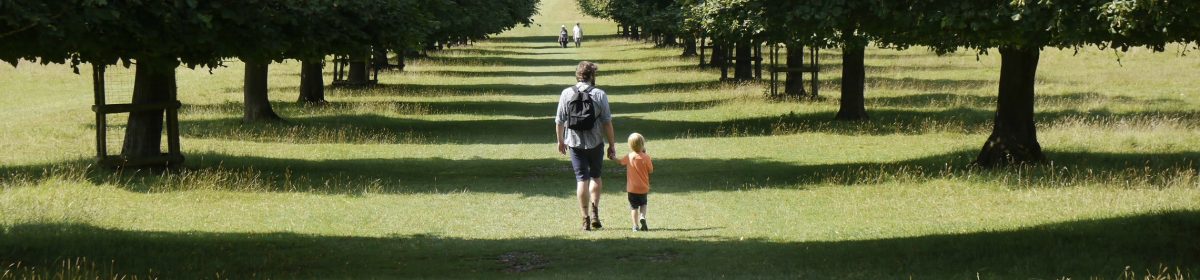

 As we all know, the merest sniff of a frost is enough to make a cucumber sick, but our late and speculative crops of runner beans and French beans were also hit, along with the last few green tomatoes. It a shame, not least because this last few days has seen the coldest October weather since 1997 – this time the gamble didn’t pay off quite as well. But think; we’re still eating the last of the fresh tomatoes and we’ve rescued enough of the frost intolerant things to make a big batch of piccallili and even some green tomato chutney. So today we cleared the remains away ready to hoe the weeds off and apply a thick layer of winter mulch to the ground that we’re not replanting immediately. The asparagus is slow to turn yellow so we’re leaving it a day or two more before we cut the fronds back, weed the whole area and apply the seaweed straight from the big sack we brought back from North Wales. It was a struggle getting it into the car because it weighed about 100lbs, but we tied the sack tight to prevent any maggots(!) escaping, and there was no smell to speak of notwithstanding the gloomy predictions of our friends. All the while the sun shone, but as it dropped towards the horizon a real chill set in. There were a surprising number of allotmenteers about this afternoon and so some lively sharing went on as we compared surpluses. That’s one of the best thing about the allotments – the community – it has its ups and downs but basically it’s rooted in sharing not in grabbing what you can.


 We did however find a nice clump of Rock Samphire down near a little cove where we watched a female seal playing with her cub for about half an hour – close inshore – it was enchanting. We also put up a snipe who waited until we were almost upon it before it shot into the air like a clay from a trap. All the usual cast of gulls, shags, crows, jackdaws and chough were either sitting on rocks looking out across the slate grey Irish Sea, sporting ecstatically in the updraught from the cliff or congregating noisily in the fields behind. A tough looking ram sporting a fetching harness of blue raddle had been about his tupping with enthusiasm if the sheeps’ behinds were anything to go by, but he was taking a break and grazing contentedly with the others. We found a solitary field mushroom whose neighbours had been trodden into the grass, and when we were thoroughly cold we walked back.

 rakes – then we were all playing. The driver was playing the resourceful hero walking back down the line, and we were all playing being abandoned in the mountains. The conductor was playing at raising our spirits with her announcements while the fault was fixed. Of course it was fixed, but when we pulled into the next station there were a small group of people having the time of their lives playing at being engineers and having manly conversations in their hi-vis jackets while a shed was unlocked and a mysterious component was found and seemed to make everyone happy again. And all that didn’t even begin to describe the bliss of rattling and clanking up the climb towards Snowdon with the wheel flanges squealing against the rails in all the twists and turns. And then there was the silence.
 At the very first stop, Edward Thomas’s poem came flooding back to me, it was almost overwhelming, and it occured to me that no-one whose life had not begun in the steam age would quite understand the poem because these days, the station name-board would be accompanied by the loud thrumming of the diesel engines under your seat. Real unexpected silence was the best teacher of that poem anyone could hope for – a truly magic moment!


 Deeply irresponsible I know, and we got properly told off by the ‘grown ups’ when we got back but they were a strange lot – they believed in the railway as fervently as they might have believed in the Second Coming. It was all too serious for us and we finally disgraced ourselves by crashing a truck. I imagine they breathed a sigh of relief to see the back of us. Now, decades later it’s easier to give them credit for their single-mindedness in building the railway. They were absolute pioneers and achieved their railway line in the teeth of a thousand difficulties. I wonder what the original volunteers think, now that the railway is a successful commercial enterprise. Knowing when to let go and allow the second and third generations take over is a real challenge, but only today it was announced that the slate region of Gwynnedd which includes the Ffestiniog Railway is to be nominated as a Unesco World Heritage site which, if it comes off, may bring even more visitors to the area. Something needs to replace the lost industries but it will create yet more stress on the culture and landscape if it’s not managed carefully and locally.


 Pig’s Snout is a very oddly shaped apple, rather square shouldered and once seen .. etc. Sadly there was no example of the Goose Arse available for inspection at Plas yn Rhiw, but I imagine there must be some resemblance shared by the Medlar – also known as Dog’s Arse by vulgar people like me.
 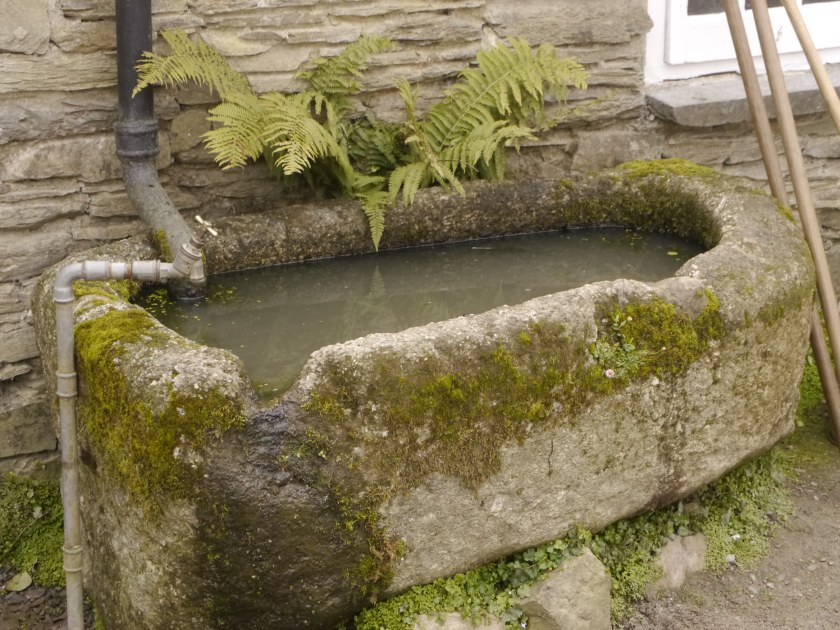 I guess we’ve all got a list of writers we know we ought to read but somehow never get round to it. For me, it’s all too often someone I’m slightly frightened to read because I’m a bit afraid I’ll be overwhelmed, and Wendell Berry fell firmly into that category. Some of the most influential books I’ve read came to me accidentally, before I’d been able to think of a reason not to read them. Wendell Berry was one of those slightly terrifying characters who wore dungarees and represented all the stuff I felt most uneasy about in America and so I steered a wide course around him whilst all the while trying to find a way of living that he could have helped me with if only I’d not been so stubborn.